INDUSTRIES

Why WeGotBots
Purpose-built for the places that never stop moving.
Industries
Warehousing & Logistics
Warehousing and logistics operations face relentless pressure: tighter delivery windows, higher order volumes,
and a labor market that makes consistent staffing difficult. AMRs address the most physically demanding and
time-intensive part of warehouse work: moving materials from point A to point B.

Where AMRs Add Value
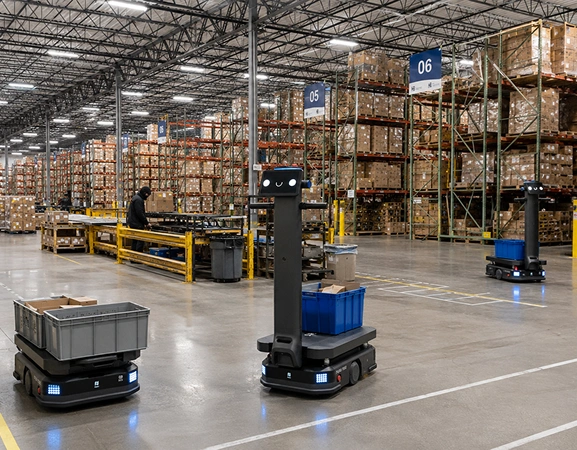
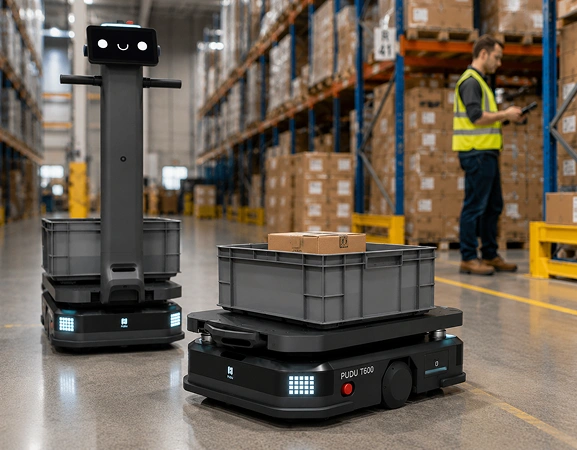
- Goods-to-person transport: robots carry totes, carts, and pallets between storage zones and pick stations,
reducing the distance workers walk per shift. - Replenishment runs: automated cycle replenishment keeps pick faces stocked without pulling pickers off
their primary tasks. - Outbound staging: robots move completed orders to packing and shipping areas on a defined schedule,
smoothing throughput.

What the Data Shows
According to the Warehousing Education and Research Council (WERC), labor accounts for approximately 65% of total warehouse operating costs. AMR deployments consistently reduce travel time per order by 30–50%, directly reducing that labor burden. These figures are from controlled deployments; results vary by facility layout and task type.
AMRs are most effective in environments with defined, repeatable transport routes and moderate to high order volume. They are less suited to highly variable picking tasks that require judgment, fine motor dexterity, or complex manipulation. We will tell you directly if robotics is not the right fit for your operation.
Industries
Healthcare
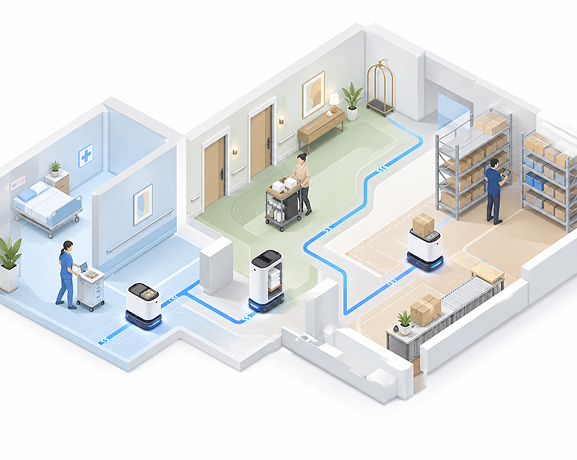
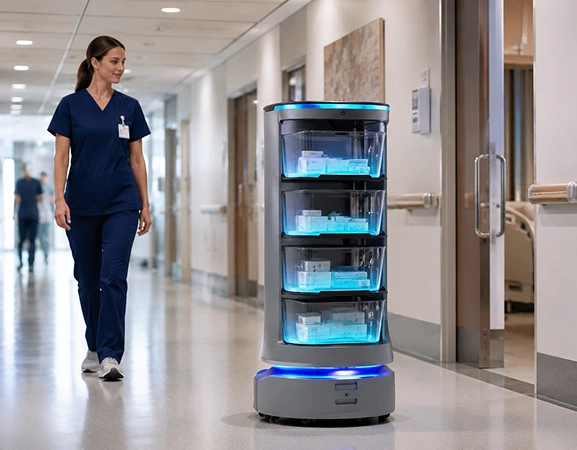
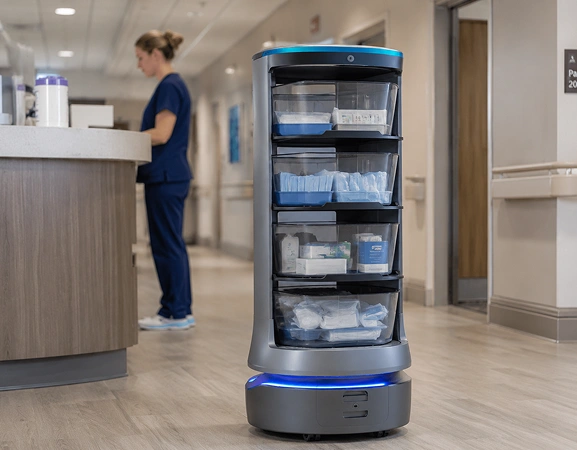
Hospitals, senior living, and long-term care facilities spend a measurable portion of clinical staff time on transport tasks that have nothing to do with patient care: moving medications, linens, lab specimens, meals, and waste through corridors and between floors. Our robots absorb a significant share of that workload.

Where AMRs Add Value
- Medication and supply delivery: robots navigate autonomously to nursing stations and patient rooms,
reducing delays and freeing pharmacy and nursing staff. - Soiled linen and waste transport: closed-container robots handle waste and soiled materials according to
infection control protocols, reducing exposure risk. - Lab specimen transport: point-to-point delivery between wards and labs with real-time tracking and chainof-custody documentation.
- Food and amenity delivery: robots handle meal trays in long-term care settings, enabling care staff to
focus on resident interaction.

Compliance and Safety
robots operate at low speed in clinical environments, yield to staff and patients, and can be integrated with
elevator control systems for multi-floor navigation. We work directly with your facilities and compliance teams
during onboarding.
Why WeGotBots
Hospitality & Retail
In hospitality and retail, the guest or customer experience is everything. Robots in these environments succeed when they are reliable, predictable, and genuinely useful. Our AMRs are deployed to handle the back-of-house and routine front-of-house tasks that slow down your team.
Where AMRs Add Value
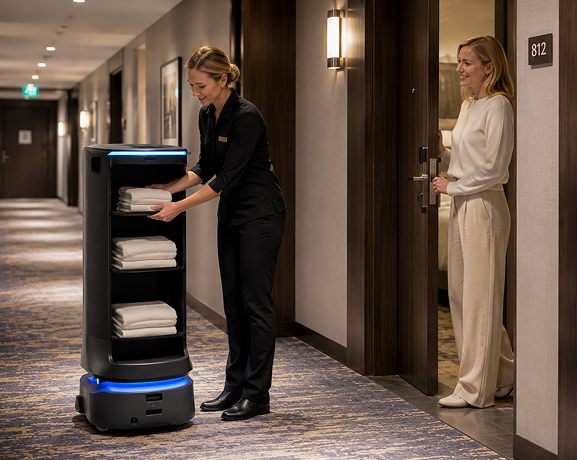
- Hotels: in-room amenity delivery (towels, toiletries, F&B orders), linen transport between floors and
laundry, trolley returns. - Retail: overnight and low-traffic restocking of floor displays, inventory scanning and gap detection, cart
collection support in large-format stores. - Food service: autonomous cart transport between kitchen and service areas in large venues, cafeterias,
and convention centers.